A hotel group finishes an eighteen-month website project. New design, faster pages, better photography, clean structured data. Six weeks later someone asks ChatGPT where to stay in that market and the group is not mentioned. The obvious conclusion is that the website was not good enough. Usually it is that the website was never the deciding factor.
Where citations actually come from
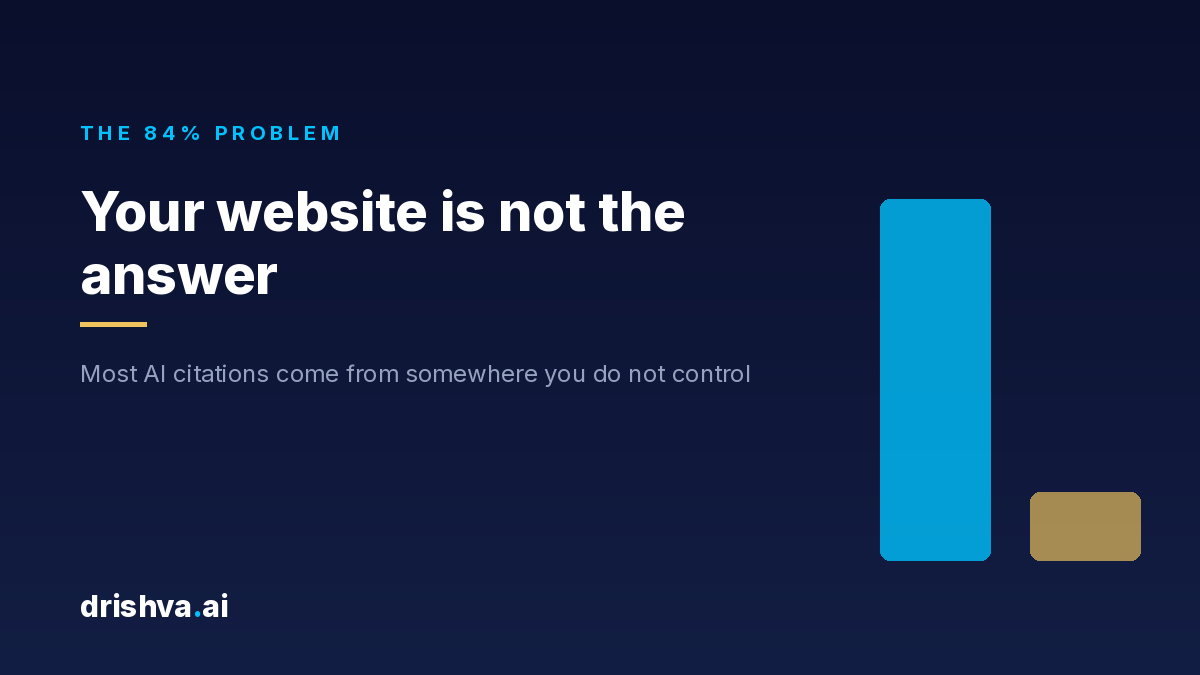
Roughly 84% of AI citations come from earned media rather than a brand's own website.Muck Rack Generative Pulse, May 2026 — 25m+ citations analysed across ChatGPT, Claude and Gemini. Reviews, guides, directories, tourism boards, forums, editorial coverage.
The reason is not mysterious. A model treats marketing copy the way an experienced traveller does: as a source with an obvious interest in the outcome. When it needs to assert that a hotel is quiet, or well located, or good for business travellers, it prefers a source that is not the hotel.
This is worth sitting with, because it inverts fifteen years of accumulated instinct. In conventional SEO the website is the asset and everything else supports it. In AI visibility the website is closer to a reference document — necessary, checked, rarely decisive.
Then engines disagree with each other
The second finding is less discussed and more consequential.
Across a study of 161,286 prompts, ChatGPT and Perplexity shared only 13% of their cited sources. Just 3.8% of sources appeared across all four major engines, and roughly 72% of cited domains appeared on exactly one engine and nowhere else.Writesonic, May–June 2026 — 161,286 prompts across ChatGPT, Gemini, Perplexity and Google AI Overviews.
So "we checked ChatGPT and we're fine" is not a measurement. It is one reading from one engine whose source preferences are shared by almost nothing else. A property can be well represented in one engine and absent from the other three, and nothing on its own website will tell it so.
What this does to a budget conversation
We say this before anyone asks, because it costs us work: a site redesign will not move your Share of Model.
That does not make the redesign wrong. A slow, unreadable or uncrawlable site is a real problem and worth fixing on its own terms. Technical foundations still matter — a site an AI system cannot read will not be cited either. But they are the floor rather than the work.
If the goal is to be named in AI answers, the money is better spent on the surfaces the models actually cite. Those are usually cheaper than a redesign and almost always unclaimed.
The surfaces that keep appearing
The specific mix varies by market and segment, which is why the citation-source log matters more than any generic list. But across the markets we have examined, the same categories recur.
- Review platforms. Tripadvisor in particular carries disproportionate weight in hotel queries, and a single geographic page can be the most-cited ranking surface for a whole city.
- Map and business platforms. Google Business Profile is the largest single citation surface for local hotel queries, and the one most often left half-complete.
- Tourism boards and destination marketing organisations. Free, permanent, treated as authoritative, and in our experience substantially unclaimed across large portfolios.
- Domestic and international OTAs. Cited heavily. Mostly outside a hotel's direct control, which is precisely why the others matter more.
- Guides and long-tail editorial. The sites that rank for "hotels in [city]" and get quoted wholesale.
Note what is missing from that list. The hotel's own website appears, but rarely as the source that decided the answer.
What we would do first
Before spending anything, three checks, all free.
- Read your robots.txt and your CDN bot settings. The commonest cause of AI invisibility is an AI-scraper block enabled by default, which nobody chose and which overrides the site's own instructions. The property ranks normally on Google and is invisible to every AI system.
- Complete your Google Business Profile properly. Every field, correct category, correct hours, photographs. Most of the available gain for a single property is here and it costs nothing.
- Ask an AI engine about your market and read the citations. Not the answer — the sources panel. Those are the surfaces that decided it. Do it on four engines, because as above, they disagree.
That third step is the whole method in miniature. Most hotels have never looked at which sources the model used, only at whether their name appeared.
The limitation, stated plainly
We measure whether a property is named. We do not claim a causal link to bookings, because we cannot control whether a named property is chosen, and no honest firm can.
What we can say is that if a property is absent from the answer, it was not considered — and unlike a poor search ranking, which still produces an impression you can count, that absence leaves no record anywhere. The conversation happened, a competitor was named, and nothing in the hotel's reporting will ever show it.
That is the argument for measuring it. Not because the number is impressive, but because it is currently the only instrument that exists.